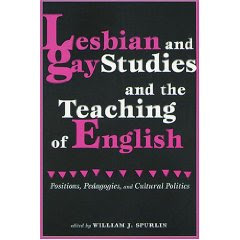
I've veered off the official reading list for awhile while I gather resources for my wiki, paper, and even my dissertation! While perusing the shelves of the National Writing Project office, I came upon the book
, Lesbian and Gay Studies and the Teaching of English, edited by William J. Spurlin. His introduction relates the personal story of his teaching English in Singapore as a young man right out of college. He didn't know how to handle the students in Singapore reading Shakespeare through their cultural lenses and says, "I was not yet familiar with the discourse of theory and the possibilities for critique it opens, and therefore was unable to deal with my sense of pedagogical (dis)location at the time..." (p. xv). Dr. Spurlin continues by telling how this experience "radically politicized my teaching; my student's (re)reading of
King Lear enabled me to interrogate more fully the relationship between the text and the cultural context in which it is read and interpreted...and to see critical reading as a struggle to (re)write the text against indeed transgress, the grain of dominant discourses, hegemonic images, and received knowledge" (p. xv).
The introduction section previews the various essays collected in this book and the connecting thread is how our society perpetuates the hegemonic view of heterosexuality as the norm and how we can "theorize, to varying degrees, queer difference as a lens through which to read, interpret, and produce texts, or as a way of reading the classroom and indeed the world..." (p. xix). I am reading this book as a companion to my chapter on Queer Theory in Critical Theory Today.
Beyond the introduction, I have read one chapter and I found it most interesting. Chapter 13: Fault Lines in the Contact Zone: Assessing Homophobic Student Writing by Richard E. Miller discusses grading the writing of unsolicited oppositional discourse. In this case, a teacher in a pre-college-level community college composition class had to deal with an essay that was crude, violent, and definitely anti-gay in theme. When this was brought up at various conferences, professors' reactions were varied, but most were summed up in one of three ways:
"read the essay as factual and respond accordingly; read the essay as fictional and respond accordingly; momentarily suspend the question of the essay's factual or fictional status and respond accordingly" (p. 237).
Scenario one would have the student removed from the classroom and turned over to authorities.
The instructor actually treated it as fictional and restricted his comments to word choice, imagined audience, and compared it to A Clockwork Orange in its depictions of violence and surrealistic detail. Many of the professors discussing this called it cowardice, but the instructor felt a sense of victory because he was able to "successfully deflect the student writer's use of his writing to 'bash' his professor, with the unexpected result that the student not only stayed in the course, but actually chose to study with (him) again the next semester" (p. 238). This was most intriguing since the instructor is an openly gay man, so he helped the student learn "to cope with an openly gay instructor with some measure of civility" (p. 238) all in the way he handled the grading of one paper.